Are You Preparing for Future Growth? Automated Storage and Retrieval Systems in Warehousing
November 11, 2026
Manufacturing and distribution facilities are under increasing pressure to improve operational efficiency, increase throughput and make better use of available space. While production equipment can be upgraded or automated to increase output, warehouse capacity can become a constraint if it does not evolve at the same pace.
When existing warehouses reach capacity, businesses may turn to offsite storage or additional facilities. Although this can provide additional space, it can also introduce more transportation, handling, labor and operational complexity.
There is another approach.
Automated Storage and Retrieval Systems (ASRS) can help businesses increase storage capacity within their existing footprint while automating how products move into, through and out of storage.
What Is an Automated Storage and Retrieval System?
An Automated Storage and Retrieval System, commonly referred to as an ASRS, is designed to automatically store, manage and retrieve products within a warehouse or production environment.
Depending on the application, products can be stored on pallets, bins, racks or other storage devices. Where a product is unsuitable for direct conveyance or does not provide the structural integrity required for automated handling, donor pallets can also be incorporated into the system.
Rather than relying on operators and lift trucks to continually transport products between production and storage locations, an ASRS brings automation directly into the storage process.
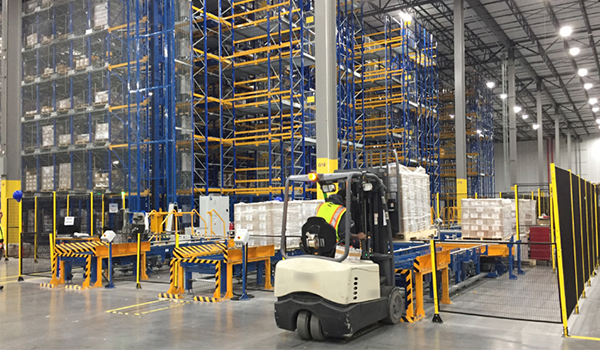
The Signode Warehouse Automation portfolio includes StorFast® ASRS, which uses cart-based automation to move pallets into and out of warehouse storage. Signode can also combine ASRS with conveyors and other automation technologies to support the wider movement of products through a facility.
The Key Benefits of ASRS
1. Make Better Use of Existing Warehouse Space
One of the principal advantages of ASRS is its ability to support high-density storage.
Traditional warehouse layouts often require significant floor space for aisles and vehicle access. Automated systems can reduce these requirements while taking advantage of vertical storage space.
For facilities where expanding the building is difficult, expensive or simply not possible, increasing storage density can provide an alternative way of creating additional capacity.
2. Reduce Reliance on Offsite Storage
When production outgrows available warehouse capacity, offsite storage can provide a relatively quick solution. However, separating production and inventory across different facilities can introduce additional product movements.
By increasing storage capacity at or closer to the point of production, ASRS can help businesses develop a more centralized approach to inventory and potentially reduce their dependence on external storage facilities.
3. Automate Product Movement
Warehouse capacity is only part of the equation. Businesses also need to consider how products reach storage and how they return when required.
Automating these movements can reduce repetitive material handling and unnecessary travel through warehouse environments.
Signode's automation portfolio goes beyond ASRS. It includes Simplimatic® conveyors, robotic palletizing and depalletizing solutions and autonomous mobile robots, alongside StorFast® ASRS.
These technologies can operate as stand-alone solutions, but Signode can also engineer them as part of a wider integrated end-of-line solution incorporating technologies such as robotics, strapping, wrapping, hooding, case packaging and ASRS.
This creates an opportunity to look at storage not as an isolated warehouse process, but as part of the overall material flow from production through packaging, storage and distribution.
4. Improve Inventory Visibility and Control
Knowing where inventory is located becomes increasingly challenging as operations grow. An automated storage environment can provide greater control over how products enter, move through and leave storage.
Integrated warehouse software can support real-time inventory visibility, improving traceability and helping warehouse teams understand what is in storage and where it is located. When combined with automated retrieval, products can be made available where and when they are required without operators spending unnecessary time locating inventory.
5. Support Productivity Through Automation
The objective of warehouse automation is not simply to replace individual manual tasks. It is to create a more predictable and efficient material flow.
Automating repetitive storage and retrieval activities can allow employees to focus on tasks where their time can provide greater value.
Signode identifies reduced labor costs, improved accuracy and increased warehouse efficiency among the potential benefits of introducing automation into packaging and warehouse operations. For higher-throughput operations, these improvements can become increasingly important as production volumes grow.
ASRS Across Different Industries
There is no single warehouse configuration that works for every business.
A pharmaceutical manufacturer may have very different inventory, traceability and handling requirements from an automotive facility. A food and beverage producer may need to manage high volumes of palletized products, while another industrial operation may have products that require specialist handling.
ASRS can therefore be designed around factors such as:
- Available warehouse footprint and height
- Product and pallet characteristics
- Required storage capacity
- Inventory profile
- Required throughput
- Inbound and outbound product flows
- Integration with conveyors and other material handling equipment
- Existing and anticipated production volumes
This flexibility allows automated storage to support applications across food and beverage, consumer goods, manufacturing and other industrial environments.
Connect ASRS to the Wider End-of-Line System
Perhaps the greatest opportunity comes from considering automated storage as part of the complete end-of-line process.
A finished product may need to be conveyed, palletized, strapped, wrapped or hooded before being transported into storage. Later, that same pallet needs to be retrieved and moved toward outbound logistics.
Signode's automation portfolio is designed around this broader view. Its automated equipment can operate independently or be brought together into an integrated end-of-line solution incorporating robotics, conveying, packaging and ASRS technologies.
This approach allows businesses to consider not only how they store more, but also how products move efficiently through the entire operation.
Are You Preparing for Future Growth? Explore Signode Warehouse Automation
For manufacturers and distributors facing increasing production requirements, warehouse capacity should not be an afterthought. Expanding the physical footprint is one option. Moving products to additional warehouses is another. But both can introduce significant cost and operational complexity.
ASRS provides another route: make better use of the space already available while automating the movement, storage and retrieval of inventory. From StorFast® Automated Storage and Retrieval Systems to conveyors, robotics, autonomous mobile robots and integrated end-of-line solutions, Signode provides automation technologies designed to help improve material flow, storage and operational efficiency.